
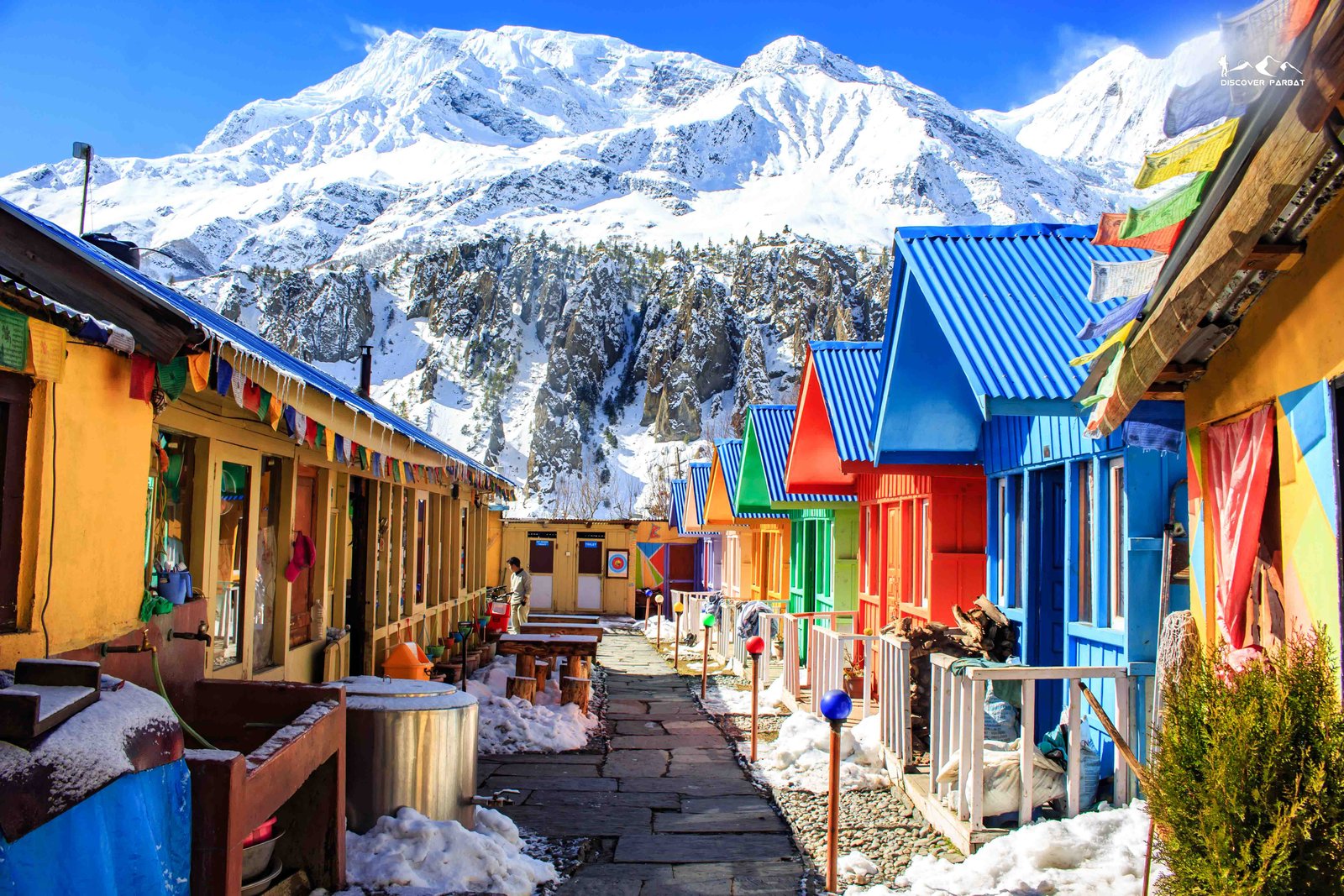
One of the best trek in the world traversing the giants of Annapurna Range


The 12 Days Annapurna Circuit Trek is one of the most popular long distance treks in Nepal and offers a unique experience to the trekking tourist, covering a variety of landscapes, high passes and over 200 Himalayan villages in the middle of Nepal. The well planned trip starts with a lovely drive from Kathmandu to Manang district's headquarters, Chame, and then slowly descends the city streets and climbs up the winding mountainside streets along the Marsyangdi River valley.
The trail winds up through pine forests, through fantastic rock formations, under the massive Paungda Danda cliff and into Upper Pisang. In the upper part of the Manang valley, where the Tibetan influence is stronger, here are trekkers' first encounters with the arid landscape. The trail passes through the village of Ngawal, which is less popular than other villages in the Lower Trekking Circuit, with views of Annapurna II and Pisang Peak, which is also a traditional village with stone houses, ancient monasteries and has a more relaxed atmosphere. The trek then continues to Manang, an important acclimatisation village, and one of the most culturally lively villages on the Annapurna Circuit Trek. The trekker can fully acclimatize to the high altitude and explore the glacial lakes, ice formations and Tibetan Buddhist monasteries in and around the region, to ensure a safer and more enjoyable crossing of the high pass ahead.
After Manang, the track gets further away and crosses into the more open high alpine landscape of Yakkharka and High Camp, bounded by snow-capped peaks. The crossing of Thorong La Pass (5416m), one of the world's highest trekking passes, is what the trek is all about, both in terms of the challenge and as a reward. The journey up to the early morning is strenuous but the views of the Annapurna and Damodar Himal ranges are unmatched as well as the descent into the sacred pilgrimage of Muktinath, both revered by the Hindus and the Buddhists. This route leads down into the dramatic Kali Gandaki Valley, the deepest gorge in the world, then to Jomsom and the lovely whitewashed stone houses and narrow alleyways of the apple-growers' village of Marpha. In this section of the Annapurna Circuit Trek, trekkers can even take a side trip to the tranquil and picturesque Dhumba Lake and the Green Lake and Blue Lake, both of which are hidden gems. It then winds on to Kobang and then to Kalopani, a serene village with close-ups viewings of Dhaulagiri and Nilgiri before the trek concludes with a drive back to Pokhara for the night.
In the past, the Annapurna Circuit was one of the great classic trekking routes of Nepal, which was traditionally trekked as a full circuit around the Annapurna massif, taking anywhere between 2–3 weeks. The growing road access in recent years to Chame and Kalopani has made this 12-day trek more time-efficient, but at the same time the cultural flavor and mountain views remain intact, making this trek perfect for trekkers with a limited amount of time who are still looking for the high altitude experience.
The trail is best for spring (March-May) and autumn (September-November) when the skies are clear and the view of Annapurna, Dhaulagiri and the other Himalayan giants is unobstructed due to the variety and the dramatic elevation changes. Beyond Manang, the rain-shadow landscapes make some sections of the route possible outside of the "wet" and "dry" seasons.
As a whole, Annapurna Circuit Trek is perfect for those who are looking for a full-fledged Himalayan adventure, with high altitudes, a rich Tibetan influence on its culture, and some of the most dramatic landscapes in and out of the river valleys and into the highland desert. This trek follows Chame, Thorong La Pass and descends through Jomsom, Marpha and the peaceful lakes near Kalopani and showcases the entire experience of one of the most iconic trekking routes in the world.
You are looking for a long trek
You want to see breathtaking views of Annapurna Range
You want a bit of cultural experience as well
You are ready for high altitude trek
You have good level of fitnes
You dont want to trek in high altitude
You want to do a short trek
We get started from Kathmandu with a bus ride to Besisahar at around 7 AM in the morning. It will have a couple of breaks for breakfast and lunch. Later, we take a shared Jeep to Chame from Besisahar, which can be around 3/3.5 hrs of drive. Itis a scenic drive going through Marsyangdi River Valley with a lot of waterfalls aaround the road. We stop in between around the waterfalls for short breaks. In total, it will be arpund 10-12 hrs. of drive from Kathmandu to Chame.
From Chame, we can see the view of Lamjung HImal. After breakfast, we start our hike to Upper Pisang. The trail goes though the river valley. The trail mostly passes through the road today. After a couple of hours hike, we reach Bhratang, where there is an apple farm. We stop for a short break here and can also try fresh Apple Juice or bakery items. After Bhratang, we pass through the road carved by cutting down the rocky mountain and cross the river at Swargadwari, where there is a scenic curved rocky mountain at the other side. After 30-40 minutes hike from there, we reach Dhikur Pokhari, where we stop for lunch.
From Dhikur Pokhari, we leave the main road going towards Manang and take right turn. We then cross the river to other side and go through a trekking trail to Upper Pisang.
From Upper Pisang, we can see stunning views of Annapurna II and IV. There is also a human face like structure at the mountain. After 30 minutes of hike, we reach Green Lake, where we take a break to enjoy the beauty of the lake. From here, we follow the road for a while before reaching a suspension bridge. Starting from the bridge, the steep uphill hike to Ghyaru starts, which can take around one and a half hours. We stop at Ghyaru for lunch, where we can also visit a small monastery and see more better views of mountains.
After lunch, we mostly go through the road to Ngawal. Initially, it will be a gradual uphill section and later we mostly go flat or gradual downhill on the road to reach Ngawal.
Most people push to Manang on a single day from Upper Pisang. However, we take an extra day to enjoy the beauty of trail and do not rush. This is why this day from Ngawal to Manang is relatively short. We mostly follow the road to Manang today. Initially we get down and then go mostly flat or gradual uphill to Manang. Depending on our pace, we have lunch either at Bhraka or Manang. We can also take a detour to visit Blue Lake as well.
Today is the acclimatization day before we continue our trek toward Thorang La. We hike towards a viewpoint at the other side of the river. We go pass the Gangapurna Glacial Lake and then steep uphill to the viewpoint. From here, we can see the whole of Manang Village and surrounding mountains. We descend down the same way.
For high altitude treks, its always a good idea to take rest days so that you can adapt to the higher elevation and also observe your health as well.
After the acclimatization day, today we start our hike to Yak Kharka. The initial section can feel a bit steep however later it becomes gradual and easy hikeand we walk over the tree line. Looking backward, we can see stunning views of Annapurna III and Gangapurna mountain. We reach Yak Kharka on lunch time or for a slight late lunch.
Today is relatively a short distance trek as its 8 KM to Thorang High Camp. It generally is a gradual uphill hike to Thorang Phedi. We also cross a long suspension bridge before reaching the Teahouses at Phedi.
Depending on the time we reach Thorang Phedi, we can either stop here for lunch or a small tea break. From here, its an steep uphill hike for an hour or so to Thorang High camp. It is 1.2 KM in terms of distance with 340m of altitude gain.
Also, we can do a short acclimatization hike to the nearby hill whixh takes aeound 20 minutes.
We wake up early at around 4 AM in the morning today as we go for the pass early. After breakfast, we start our hike from the Teahouse at around 4:30 AM. Till the pass, it is around 4 KM of distance with 540m of elevation gain. Initially to the teashop in between the trail, it could feel a bit steeper, however, later its mostly gradual uphill. We take it slow with multiple small breaks in between for sufficient rest and adapting to the altitude. Generally, it takes around 3-4 Hrs. of hiking to Thorang La. We take around 10-15 minutes stop at pass for break and pictures and start our descend towards Muktinath. After a steep descend of around 3 hours, we reach Phedi, base at the other sides where we stop for lunch break, at around 4,100m. From here, its mostly gradual downhill to Muktinath.
After maximum of an hour hike down, we reach Muktinath, where a hot shower awaits at the hotel after the tiring hike crossing one of the highest trekking passes. After some rest, we walk to the Muktinath Vishnu Temple of Muktinath. Muktinath means the the god who grants liberation from the cycle of birth and death or reincarnation.
From Muktinath onwards, we start seeing Dhaulagiri range mountains. We go to the other side of the river, avoiding the major highway. We still hike through the road mostly but with mostly no vehicles around. The deserted mountainous landscape with Dhaulagiri , Nilgiri and Tukuche peaks view is amazing from the trail.
We stop for lunch at Kagbeni, which is another popular religious spot on the trail and from here on, we mostly trek through the banks of Kaligandaki River to Jomsom.
Today, we initially go gradual uphill to Dhumba Lake, a small crystal-clear blue lake, with reflection of mountains. Later we continue going gradual downhill mostly on the road to Kobang via Marpha. We stop at Marpha for lunch, which is a cute little white town with a monastery. It's again by the side of holy Kaligandaki river with views of Dhaulagiri range.
Today, we trek down to Kalopani. However, in between we make a detour to Titi Lake, which is situated in between the pine forests. We initially go parallel to river and cross it at one point. Before reaching the lake, there is an section of steep uphill where we gain around 180m of elevation. After spending some time at lake, we return back and then head towards Kalopani. We spend the evening rewinding the memories fro the past 10 days around the trail as its the last eveningh.
We take a shared vehicle (Jeep/EV Micro) back to Pokhara. Except some sections, most of the road is blacktopped and is a comfortable journey. It can take around 6-7 Hrs. of drive with a couple of breaks in between for lunch and snacks.
It's a challenging trek due to the Thorong La Pass (5,416m), but with proper acclimatization at Manang, it's manageable for trekkers with prior hiking experience and good fitness.
Spring (March–May) and autumn (September–November) offer the clearest skies and best mountain views, though the rain-shadow area beyond Manang is trekkable even in shoulder seasons.
Yes, you'll need an ACAP (Annapurna Conservation Area Permit) which can beeasily arranged in Kathmandu or Pokhara. You can also get the permit online.
No technical climbing skills are needed, but basic fitness and some high-altitude trekking experience are recommended for a safer, more comfortable crossing of Thorong La.
Teahouses and lodges are available at every overnight stop, offering basic rooms, hot meals, and charging/wifi facilities (paid, especially at higher altitudes).
While independent trekking is possible, hiring a licensed guide or porter is highly recommended for safety, navigation, and support crossing Thorong La Pass.